

Toronto’s real estate market was slow in February. Average prices are down across all market segments with detached properties seeing the biggest monthly decline. Uncertainty around the Canada–US trade agreement and rising oil prices—along with their potential impact on inflation and interest rates—is weighing on the real estate market. While detached and semi-detached sales rose slightly, price declines deepened as sellers adjusted expectations.
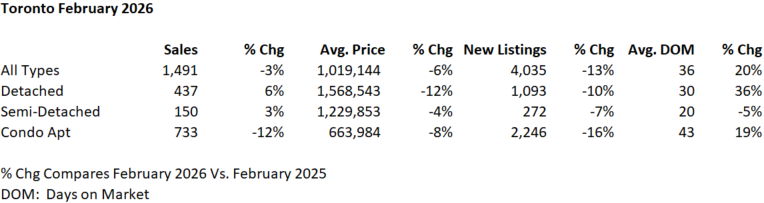
Total transactions were down by 3% led by slow condo sales. Despite the slight uptick in sales for detached and semi-detached properties, note that Jan-Feb 2025 sales were anemic as Canada braced for tariffs from the incoming US administration in January 2025.
The winter months are normally a harbinger of the spring market. If that’s the case, we expect a weak spring market as year to date (YTD) freehold sales are down 5% compared to YTD 2025 and 17% down from the average of the past 5 years (2022-2026). Meanwhile YTD condo sales are down 17% compared to YTD 2025 and down 30% from the average of the same five year period.
As mentioned several times in this newsletter, delays at the Landlord and Tenant Board (LTB) are creating significant challenges for the resale market—especially the condo sector, which has been heavily investor-driven over the past decade.
For example, a client of mine was initially notified of a hearing in August 2024, scheduled for September 2024. That hearing was postponed by the other party and only took place this week—a year and a half after the original date. Although my client ultimately won the case, the process consumed considerable mental energy and paralegal costs.
Even if this case had been resolved in half the time, it illustrates why investors remain cautious: buying real estate while being at the mercy of the LTB can be unpredictable and stressful.
There is significant pent up demand in Toronto’s real estate market. The average number of sales from 2013-2015 was 34,921 compared to the last 3 years (2023-2025) of 24,142 sales. This means that there should have been 10,000 more transactions in each of the last 3 years. This represents 41% fewer transactions that actually took place in Toronto. Given the negative news surrounding the real estate market in Q1 2026, I suspect that many many sellers who were ready to sell over the winter are postponing listing until the prime spring market. If sellers adjust their price expectations to the new norm, there could be a slight rebound this year.
Shen Shoots The Breeze
Travel Tips for Your Next Trip. With March break upon us and summer travel creeping into people’s minds, I’ve been thinking about travel planning. Over the years, we’ve learned a few tricks—some the easy way, some the hard way—so I thought I’d share a few travel tips in case you’re booking a trip this year.
Tip 1: Don’t always assume round-trip tickets are the best dealMany people automatically search for round-trip flights, but sometimes booking two one-way tickets can give you more flexibility—and occasionally even save money. You might fly out with one airline that has the perfect departure time and return with another that works better for the trip home. It also makes changes easier if plans shift, since you only need to adjust one leg instead of the entire booking. It doesn’t always work out cheaper, but it’s worth doing a quick comparison before you hit “purchase.”
That said, during the winter months, I now lean toward round-trip tickets when the cost is comparable. On a recent business trip to New York City, my plans were cancelled due to a major winter storm. Had I booked a round-trip ticket, I would have received a full refund from Air Canada. Since I booked two one-way tickets, I got a full refund for the outbound flight, but only a credit for the return portion, which was booked separately. Lesson learned!
Tip 2: Let the internet do the heavy liftingUse tools like Google Flights or Skyscanner to compare prices and options. A few quick strategies:
- Check both one-way and round-trip pricing.
- Set price alerts to catch drops.
- Be flexible with departure times or nearby airports.
Tip 3: Search widely, but book smartSites like Expedia, Kayak, and Priceline are great for comparing prices and seeing what’s available. I use them all the time when planning a trip.
But when it comes time to book, I often prefer going directly through the airline or hotel — whether that’s Air Canada or another carrier. If a flight gets delayed, cancelled, or changed, dealing directly with the airline is usually much simpler than trying to sort things out through a third party in the middle.
Tip 4: Don’t forget your pointsIf you collect travel points, check partner airlines. Many loyalty programs let you redeem points not just on their own flights but also on partners. For example, Aeroplan points with Air Canada can be used on many airlines in the Star Alliance network. Partner flights sometimes offer better availability or value, especially for longer international trips. We recently purchased premium economy trips via our Aeroplan points but a portion of our trip flies with All Nippon Airways. A little extra searching can stretch your points further.
Bonus tip: Get your Nexus card. What’s stopping you? This isn’t about saving money, but it will save you time. Nexus lets you breeze through airport security for domestic and international flights—and if you’re driving to the U.S., there are Nexus-specific lanes. You don’t need to be a Canadian citizen; permanent residents can also apply. Trust me, it’s worth it.
Those are a few travel nuggets from our household to yours. If you have a favourite travel hack, send it my way—I’m always looking for ways to make the next trip a little smoother.