

Transactions in Toronto’s real estate market last month were up 9% compared to April 2025.
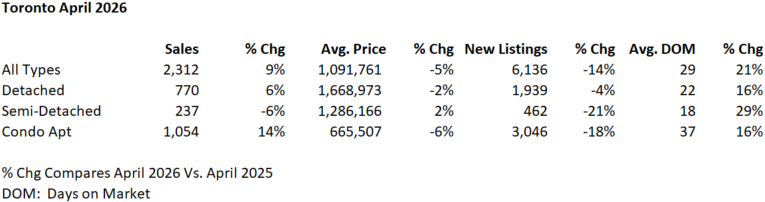
Condominium apartment sales led the increase, rising 14%, followed by detached freehold sales of 6%. The rise in condo activity was supported by improved affordability, with average condo apartment prices down 6% year-over-year, while overall market prices was down 5%.
The market tightened as new listings fell 14% compared to a year ago, with many sellers remaining on the sidelines amid economic uncertainty related to higher oil and transportation costs and their potential impact on inflation, interest rates, business investment, and employment.
With fewer new listings and increased sales activity, months of inventory (MOI) declined from 6.5 months at the end of January 2026 to 4 months by the end of April 2026. The tightening was more pronounced in the freehold market: detached home MOI fell from 5.8 months to 3.2 months, while semi-detached properties declined from 3 months to 2.1 months over the same period. The condo market, while still slower overall, also showed improvement, with MOI decreasing from 7.6 months to 5 months since the beginning of the year.
The sales-to-new-listings ratio suggests buyers still hold the advantage in the condo market, largely due to reduced investor demand as rents soften amid lower immigration levels. Meanwhile, the freehold market has shifted from a buyer’s market toward balanced conditions, as lower sales activity over the past three years has created pent-up demand among buyers who are still purchasing at prices roughly 20% below the Q1 2022 peak.
My crystal ball is murky as we await a new free trade deal with the US and see how higher fuel and transportation costs will affect everyday products. As for what to expect for the rest of 2026, the price differential between freehold and condos currently sits at approximately $580,000 – about $40,000 less than what we’ve seen in the past 3 years. My expectation is that this gap will widen again as pent-up demand and improved affordability support price growth, particularly in the freehold market.
Shen Shoots The Breeze
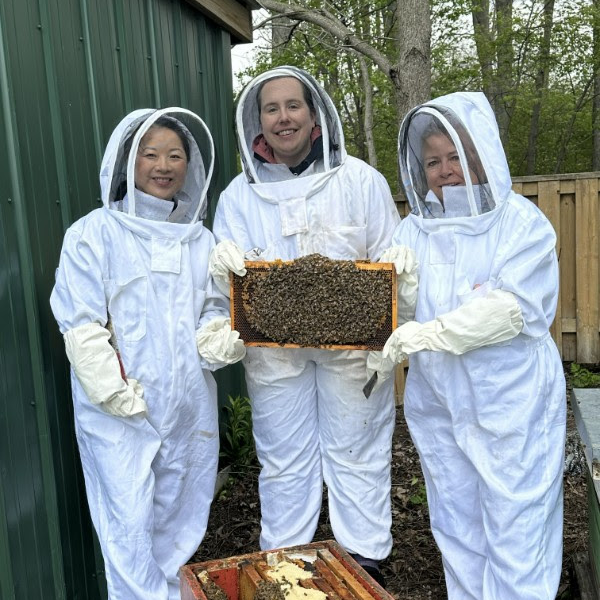
This past Saturday, two of my curling friends and I headed to Thames River Melons farm for their “Meet the Bees” experience — and let me tell you, it was equal parts educational, fascinating, and not at all terrifying (we felt very safe amidst thousands of potentially stinging creatures). This was my first time getting truly up close and personal with thousands of pollinators.
Upon arrival, we suited up in full beekeeper gear and spent nearly three hours with Nathan, the farm’s head beekeeper, learning far more about bees than I ever expected to know. The farm keeps bees primarily to help pollinate their crops, while the honey is the delicious side benefit.
Going in with almost zero bee knowledge, here are some of the many things I learned:
– A worker honeybee lives only about 6 weeks during the busy summer season.
-Bees can travel up to 5 km from their hive searching for nectar and pollen. Over their lifetime, a worker bee may fly ~800 kilometres.
– A single worker bee produces only about 1/12 of a teaspoon of honey in her entire life — which somehow makes every spoonful of honey feel dramatically more valuable.
– A healthy hive can produce 30–60 pounds of surplus honey in a good season.
– Bees are excellent navigators and use landmarks, the sun, and scent to find their way back to the correct hive.
– There is only one queen per hive, and her primary role is laying eggs to keep the colony alive and growing.
– If the queen dies or disappears, the hive notices almost immediately within 15 minutes to 2 hours. Without her pheromones, the colony goes into full emergency mode and starts raising a replacement queen.
– Depending on the season, a hive can contain anywhere from 20,000 to 60,000 bees.
– Beekeepers don’t need to check hives every day. Most inspections are to monitor hive health, swarming activity, and pests like varroa mites.
Aside from the beekeeping experience, Thames River Melons also offers Pick-Your-Own fruits and vegetables throughout the growing season. I’m told mid-to-late July is the sweet spot if you want the best variety. They also have weekly produce box deliveries and even a beef subscription program.
I’ll admit: the second I got home, I started researching urban beekeeping bylaws. Unfortunately, my property doesn’t meet the 30 metre setback requirements — and more importantly, my husband is allergic to bee stings. The beekeeper also informed us that for beekeepers getting stung isn’t a matter of IF, but WHEN. So, in the interest of preserving both my marriage and my husband’s health, my aspiring beekeeper era will have to remain on hold for now.