

Toronto’s real estate market in March 2026 was softer than a year ago. While transaction volume held relatively steady, economic uncertainty—ranging from inflation and interest rate expectations to US–Canada trade relations—continues to weigh on buyer sentiment and pricing.
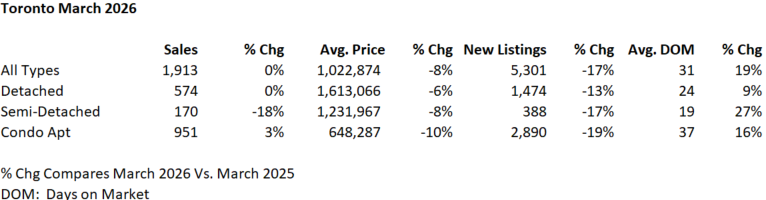
Despite this, affordability has improved meaningfully. Average prices are down approximately 17% from the 2022 peak, while mortgage rates are now comparable to levels seen in Q2- 2022. Buyers are also benefiting from increased selection, with 8,889 active listings across Toronto at the end of March.
A less reported trend, however, is the recent pullback in new supply. New listings in Q1 2026 declined by 15% compared to Q1 2025. Inventory levels have also tightened: detached homes are now at 3.5 months of inventory, down from 5.8 months at the start of the year. The condominium apartment segment is showing similar improvement, with inventory declining to 5.2 months from 7.6 months at the end of January.
On a month-over-month basis, sales rose 28% from February to March—outpacing gains seen over the same period in 2025 (24%) and 2024 (17%). With supply tightening and pent-up demand beginning to surface, some areas are seeing offer dates and competitive bidding. However, unlike the highly competitive conditions of 2021–2022, today’s buyers remain more measured, and even in multiple-offer scenarios, pricing is generally in line with broader market trends.
While it remains early to draw definitive conclusions, the recent increase in sales activity, combined with improving affordability and underlying demand, suggests a gradual stabilization may be underway in Toronto’s real estate market.
Shen Shoots The Breeze
The Spring market is here. I don’t usually write about real estate topics—normally I leave that to my trusted partner—but I wanted to share a few thoughts on DIY buyers (self-represented party is the official term) and “sign calls” (when someone reaches out directly to see one of our listings).
While I strongly believe in the value of having an experienced agent, I also understand why some buyers—especially those who’ve been through the process before—choose to represent themselves. If it’s worked for you in the past, you might stick with it.
There’s also this idea that going directly to the listing agent is a win-win: the buyer gets a better deal, and the agent earns more commission. In theory, that’s not wrong—but in practice, it happens far less often than people think. Multiple representation (where one agent represents both sides) likely makes up around 5% of transactions. For context, the last time we represented both buyer and seller was in 2023.
In today’s world—scams and safety concerns—agents are a bit more cautious about meeting complete strangers at a property without vetting. So if you’re a DIY buyer, a little effort upfront can go a long way.
When you first reach out (email, text, or message), be clear and direct. Let the agent know you’re not working with a realtor, that you’re pre-approved, and whether you’re buying for personal use or investment. It helps signal that you’re serious, not just casually browsing.
It also helps to have your ducks in a row. Be ready, if asked, to provide:
- Government-issued ID
- Mortgage pre-approval
- Proof of down payment
- Employment verification
- Credit report (optional)
- Access to your deposit
At the end of the day, sellers want to feel confident they’re dealing with a real, qualified buyer who can close. When an agent works with a DIY buyer, that confidence has to come directly from the buyer.
Bear in mind that the listing agent represents the seller—not the DIY buyer. They can’t advise you on pricing, strategy, or what clauses to include unless you formally engage them. As a DIY buyer, you’re responsible for your offer and the details that come with it. You may want to have a good real estate lawyer involved earlier in the process – find someone who is careful but not so overly cautious so the deal won’t ever get done.
One thing I’d suggest—don’t lead with commission. Bringing it up right away can come across as putting the cart before the horse. First figure out if you even like the property.
And lastly, just be courteous. It sounds simple, but it matters. Agents are much more likely to make time and engage with buyers who are respectful and straightforward- being too secretive won’t help an agent to be as responsive to you.
Final public service notice! If you have a property in Toronto, make sure you submit your Vacant Home Tax declaration prior to April 30 2026.